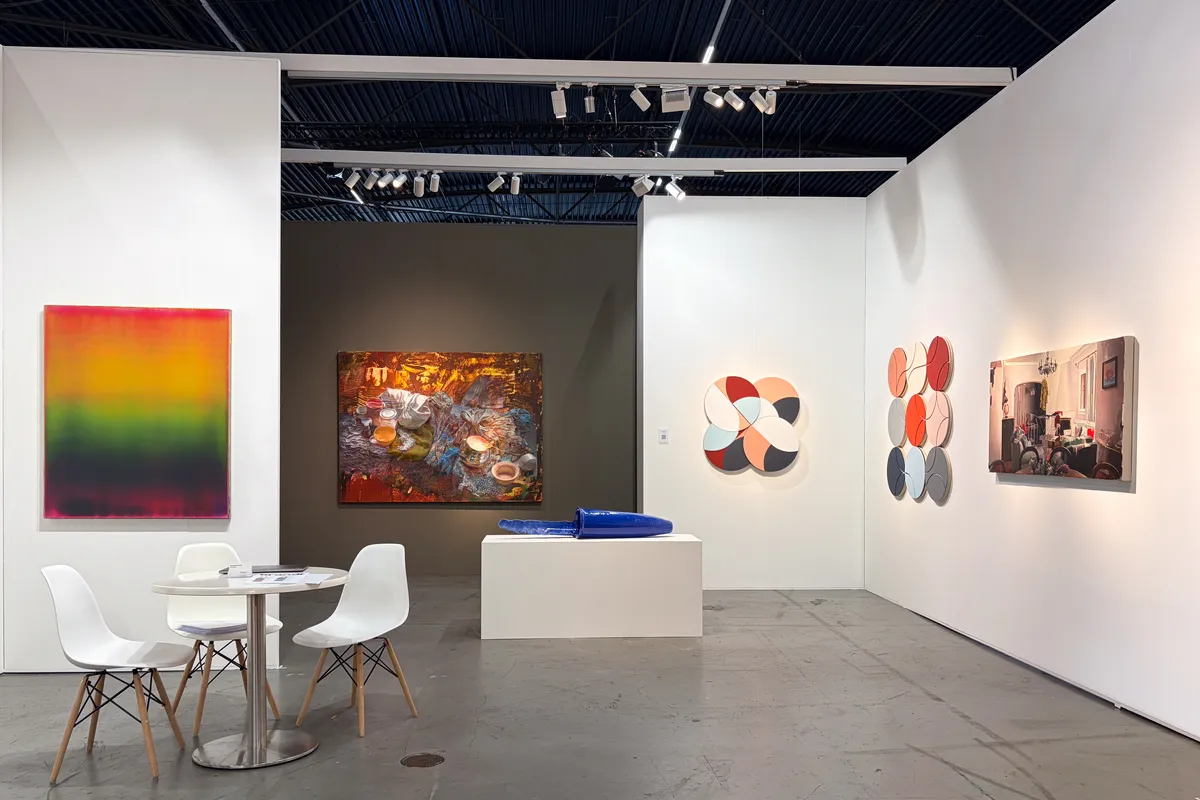
Omar Ibañez
-
 Chromatic in Motion 2, 2026
 -
Moving Grid 2b, 2026
-
Concave Grid II, 2021
-
Moving Grid 4b, 2020
-
Two-stage Grid I, 2020
-
Set Theory I, 2019
-
96 x 140 ø, 2018


Omar Ibáñez's work is comprised of a sequence of material responses to theoretical hypotheses surrounding painting and its relationships with geometry, image perception, and the analysis of movement. His practice follows an almost-scientific process, resulting in works that embrace construction criteria derived from empirical learning around these questions, and that allow both Ibáñez and the viewer to pave the way for subsequent inquiries.
One of the lines of exploration pursued by Ibáñez, stemming from dialogues with historical artists like Rauschenberg and Stella, focuses on the physical construction of the medium of painting. He reconsiders the support as an area of plastic exploration not secondary to representation. Thus, in several of his works, Ibáñez exposes the presence of the stretcher bars, revealing the intrinsic three-dimensional dimension of the canvas and its physical structure as the protagonist. From these processes of unfolding, Ibáñez also derives his interest in the plastic integration that results in pieces in which structure and representation respond to each other in a necessary and inseparable way. More recently, the artist pushes these processes to abandon the conventional spatial relationships of painting in the gallery, confronting the landscape to the point of relinquishing any constraints and even gravity.
In his work, the artist is also interested in exploring on the border between the illusion of geometry and abstract representation and its possible dissolution.
When Ibáñez approaches the idea of the wall as emancipation from the painting-canvas relationship, he makes direct interventions in it that delve into its interior, constructing a three-dimensional negative image that requires the viewer's movement to be deconstructed. In this way, the work offers two simultaneous possible views: that of the apparent image and that which reveals the spatial trickery behind its appearance. Similarly, Ibáñez creates works that avoid a stable configuration to favor the presence of elements that can be combined differently, giving rise to multiple images.
Ibáñez's entire work can be understood as an exercise that arises from the retrieval of a strong manual connection with artistic work. It proposes a dual conceptual direction in which the artist is dedicated to reveal the structures that underpin fiction in representation, while simultaneously seeking to create new illusions.